Know the Difference: “National” vs. “National of the United States”
 Admin
AdminWhen I first began my journey to declare and claim my status as a “National,” I struggled to understand the numerous terms and definitions related to the different legal statuses that might apply to an American individual. It was especially challenging to navigate these concepts due to the intentional or unintentional obfuscation surrounding them.
To make sense of it all, I decided the best approach was to take it one step at a time—just like the saying goes: “You eat an elephant one bite at a time.”
My first question was: What is a “National”?
To find a definitive answer, I turned to the U.S. Code and other legal sources, knowing that statutory definitions would be the most authoritative. I found what I was looking for in 8 U.S. Code § 1101(a)(21), which defines a “National” as:
“A person owing permanent allegiance to a state.”
This was a great start. However, I quickly discovered a wide range of similar-sounding terms—some statutory, others non-statutory or colloquial. Aside from “American National,” most of these terms were not statutory and not synonymous with “National” and often introduced confusion, misdirection, and distraction from understanding the true concept of the “National” status.
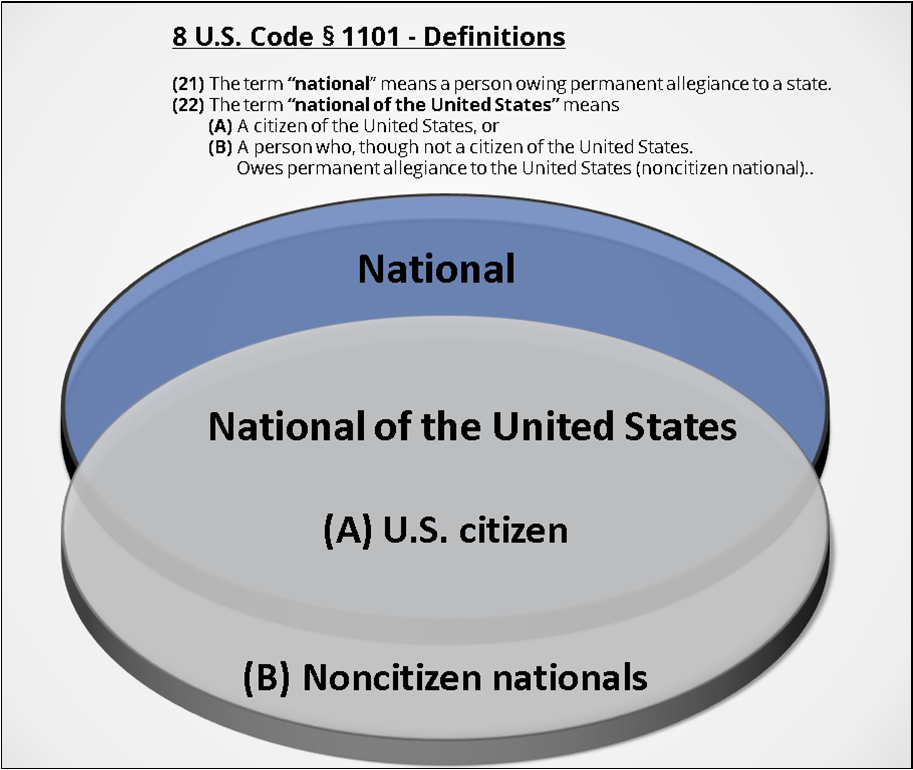
To simplify things, this article focuses solely on two statutory definitions found in U.S. Code. These two definitions form a foundational understanding and should help reduce confusion for those starting their journey. They are both found in 8 U.S. Code § 1101(a), specifically subsections (21) and (22):
- (21) The term “national” means a person owing permanent allegiance to a state.
- (22) The term “national of the United States” means:
(A) a citizen of the United States; or
(B) a person who, though not a citizen of the United States, owes permanent allegiance to the United States.
Understanding and contrasting these two definitions is critical.
The definition in subsection (21) describes a “National” as someone who owes allegiance to a state—not to the federal government.
In contrast, subsection (22) defines a “National of the United States”, which appears similar but is fundamentally different. It is broken into two categories:
- (A) Citizens of the United States, and
- (B) Non-citizen nationals: individuals who are not U.S. citizens but still owe permanent allegiance to the United States.
The deeper implications of “National” status go far beyond these definitions. However, the goal of this article is to provide the groundwork—basic yet critical information to help you get started on your path to understanding and, ultimately, freedom.
To assist in visualizing the difference between these definitions, refer to the Venn diagram provided below.